Data is anti-fascist


Last week, this newsletter was refreshingly apolitical. Well, that was then.
Chapter 1
What they want you to believe about immigrants
You don't need to travel too far up the branches of White House Deputy Chief of Staff Stephen Miller's family tree to find immigrants. As his uncle explained in a 2018 article for Politico excoriating his nephew's hard-line position on immigration, Miller is the descendant of the Glosser family, the patriarch of which arrived at Ellis Island in 1903, unable to speak English.
This did not prove to be an insurmountable problem. Glosser brought over his family, some of whom made their way to Johnstown, Pa. They opened what became a successful, regional department store chain — one of countless stories of immigrants coming to the United States to shape and be shaped by it.
But this traditional story of American success has seemingly done little to moderate Stephen Miller's view of immigration. He serves as the rhetorical and practical engine of Trump's immigration dragnet, a sweeping, ripping effort that reporting suggests Miller feels is moving too slowly.
On Thursday, Miller, responding to the Indiana state senate's rejection of a more Republican-friendly congressional map, framed his efforts in terms that would be familiar to anyone who is aware of the "great replacement" conspiracy — the toxic, dangerous idea that immigrants are being encouraged to come to the U.S. to reshape the population.
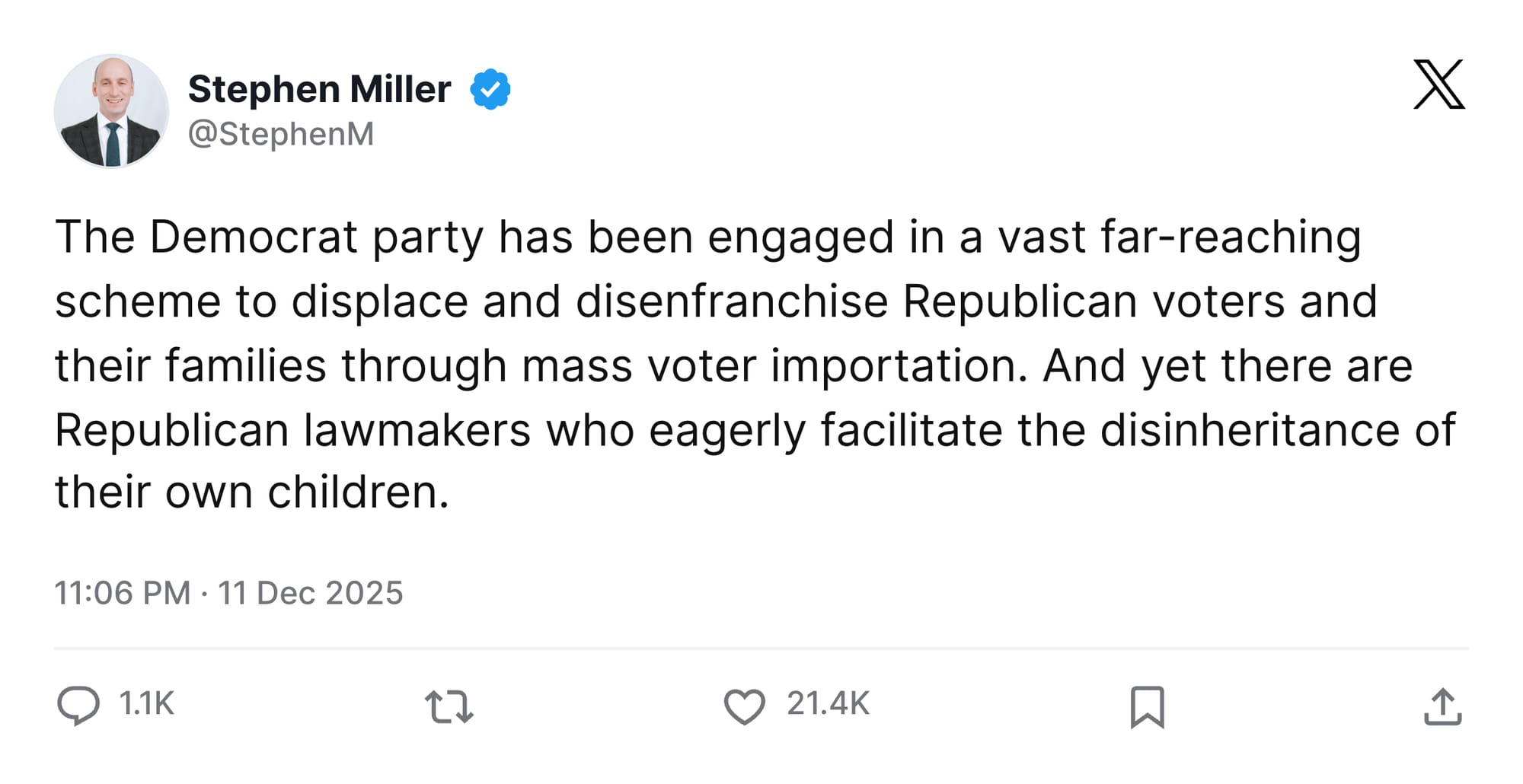
Notice that Miller describes this theoretical "scheme" in partisan terms: Democrats are trying to replace Republicans by "mass voter importation." This, he asserts, will "facilitate the disinheritance" of Republicans' children.
There's one deviation here from standard "great replacement" rhetoric: Miller puts it in partisan rather than racial terms. But this, too, is demonstrably false.
In September and October, KFF conducted polling in which they asked immigrants to the U.S. how they viewed politics and Trump. The results? The politics of immigrants to the U.S. mirror the politics of Americans overall — not really that surprising when you consider that nearly everyone in America is here due to immigration.
KFF broke out the immigrants with whom their pollsters spoke into three groups: All immigrants, naturalized citizens and citizen immigrants who were registered to vote. In each case, the immigrants were most likely to identify as independent or apolitical, while being slightly more likely to be Democrats and slightly less likely to be Republicans. A blue wave, it isn't.
How to read this chart: The partisan identities of each of the three groups above are shown in the outer ring of the diagram. The overall partisan composition of Americans, measured by Gallup, is shown in the inner circle.

I've highlighted one part of the third chart, showing the partisan identity of registered immigrant voters. They are 8 percentage points more likely to be Democrats (and 3 points less likely to be Republican). This, Stephen Miller would have you believe, is the urgent driver of a nefarious scheme to rebalance politics to the left.
But we don't really need this poll. Miller's assertions are self-evidently false if you just look at politics as it stands. As I wrote in my 2023 book "The Aftermath" (makes a great Christmas gift!), no state better reflects the more-diverse, more-immigrant-heavy future population of the U.S. than Florida — and Florida is hardly a deep blue state.
The KFF poll also asked specifically about Trump. Immigrant voters were as likely to approve of his presidency as Americans overall (comparing KFF's numbers to contemporaneous polling from YouGov), even if they were slightly less enthusiastic. Immigrants who identified as independents were actually more supportive of Trump.
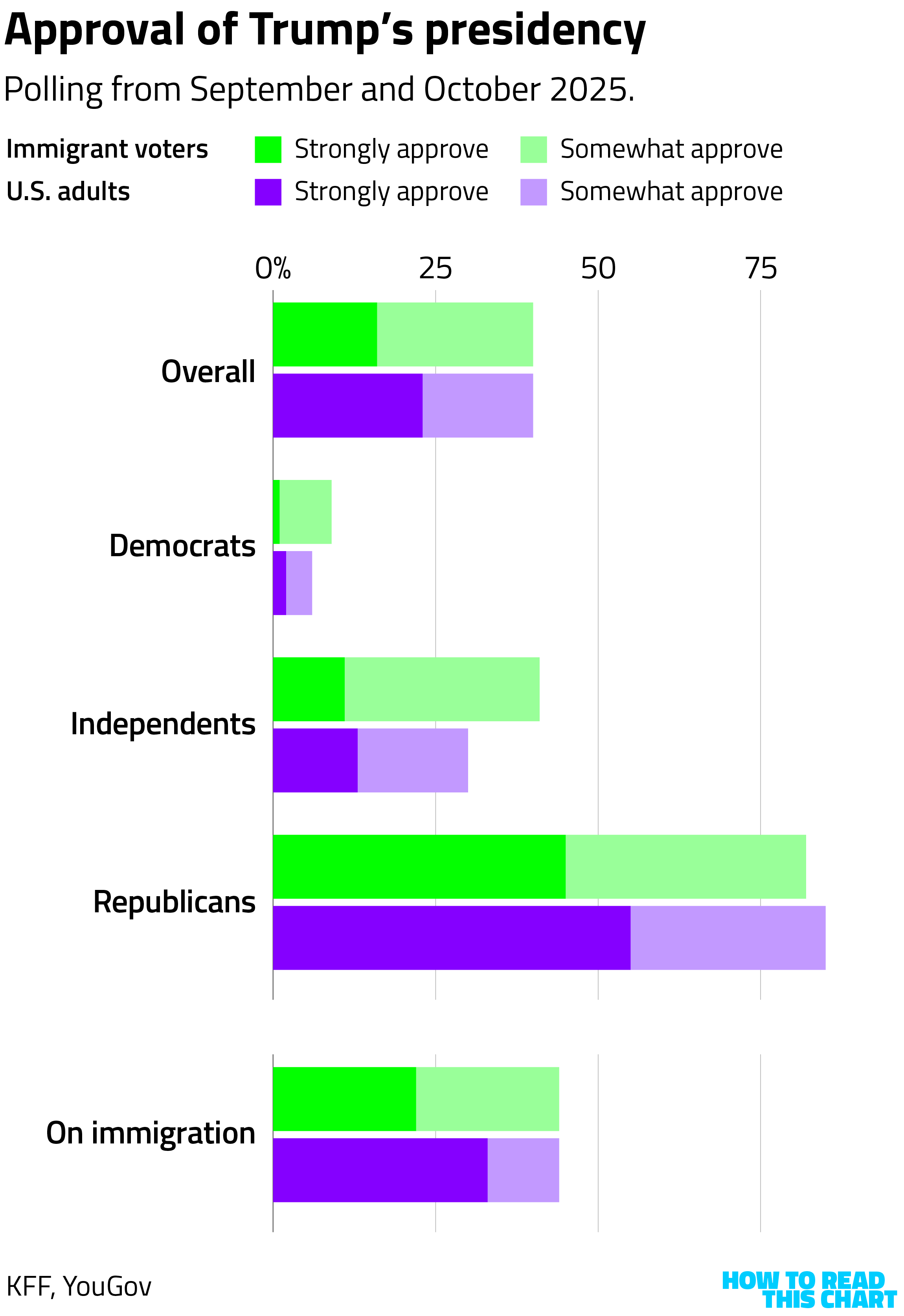
In fact, on the specific issue of immigration, immigrants were as likely to approve of Trump as were Americans overall.
So why does Miller claim that immigration is some big scheme to freeze out Republican voters? Because he recognizes that partisanship is a potent, acceptable lens through which to fearmonger. Miller is and has long been committed to rejecting immigration; he sees partisan insecurity as a way to bring other Republicans on-board with his efforts.
It reminded me of a piece I wrote for MS NOW last week, exploring how the administration's recent increase in inflammatory anti-immigration rhetoric compared to 1930s Germany. Then, historians told me, the Germans had a scheme to excise Jews from German society but needed to build political power to do it. Trump seems to operate in reverse, using demagoguery to build power. But Miller's approach above aligns with history more neatly.
One historian, University of Maryland Professor Emeritus Jeffrey Herf, explained that one of the talents deployed by German propagandist Joseph Goebbels was his cynicism. He was "lying all the time," Herf said — but because he argued that everyone lied all the time.
But there is an objective, observable reality, one that sits at odds with Miller's presentation of immigration. The data — unemotional, precise — demonstrates that the fascist project of the present isn't a competition between two sets of lies but between a lie and a truth.
Chapter 2
Happy birthday, from the National Park Service
We also learned this week that the schedule of days on which national parks will have free admission has been overhauled for 2026.
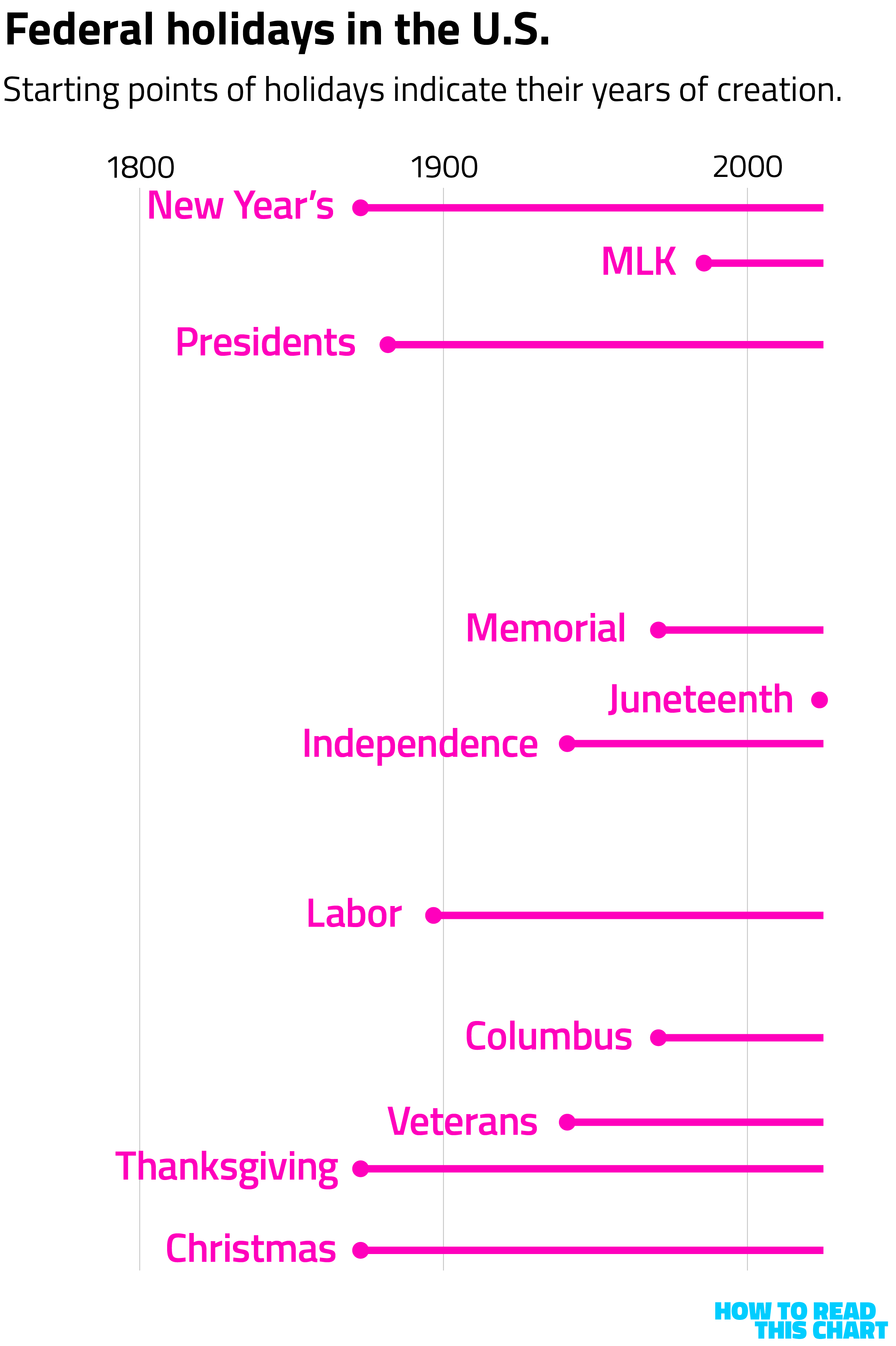
I assumed, upon first reading news articles about the shift, that this schedule aligned with federal holidays, which made me curious about when those holidays were instantiated. So — you're not going to believe this! — I made a chart.
Turns out, a lot of the 11 federal holidays are relatively new. Five of them have been around for less than a century.
But this isn't actually how national park free-admission days work. Which makes sense: These are federal holidays! The federally run parks are, for the most part, closed. Instead, the free-admission schedule for past years included park-related celebrations, like National Park Week and National Public Lands Day. They also included some federal holidays: Martin Luther King Jr. Day, Juneteenth and Veterans Day.
So what's changed? Well, only Veterans Day survived from that bunch, for reasons that I will leave to you to glean. Memorial Day was added to the mix, as was the entire Fourth of July weekend.
Oh, and a bunch of birthdays were added! George Washington's birthday, Teddy Roosevelt's birthday, the National Park Service's "birthday" (as the new calendar puts it) and, let's see here … oh! Donald Trump's birthday! Who would have guessed.
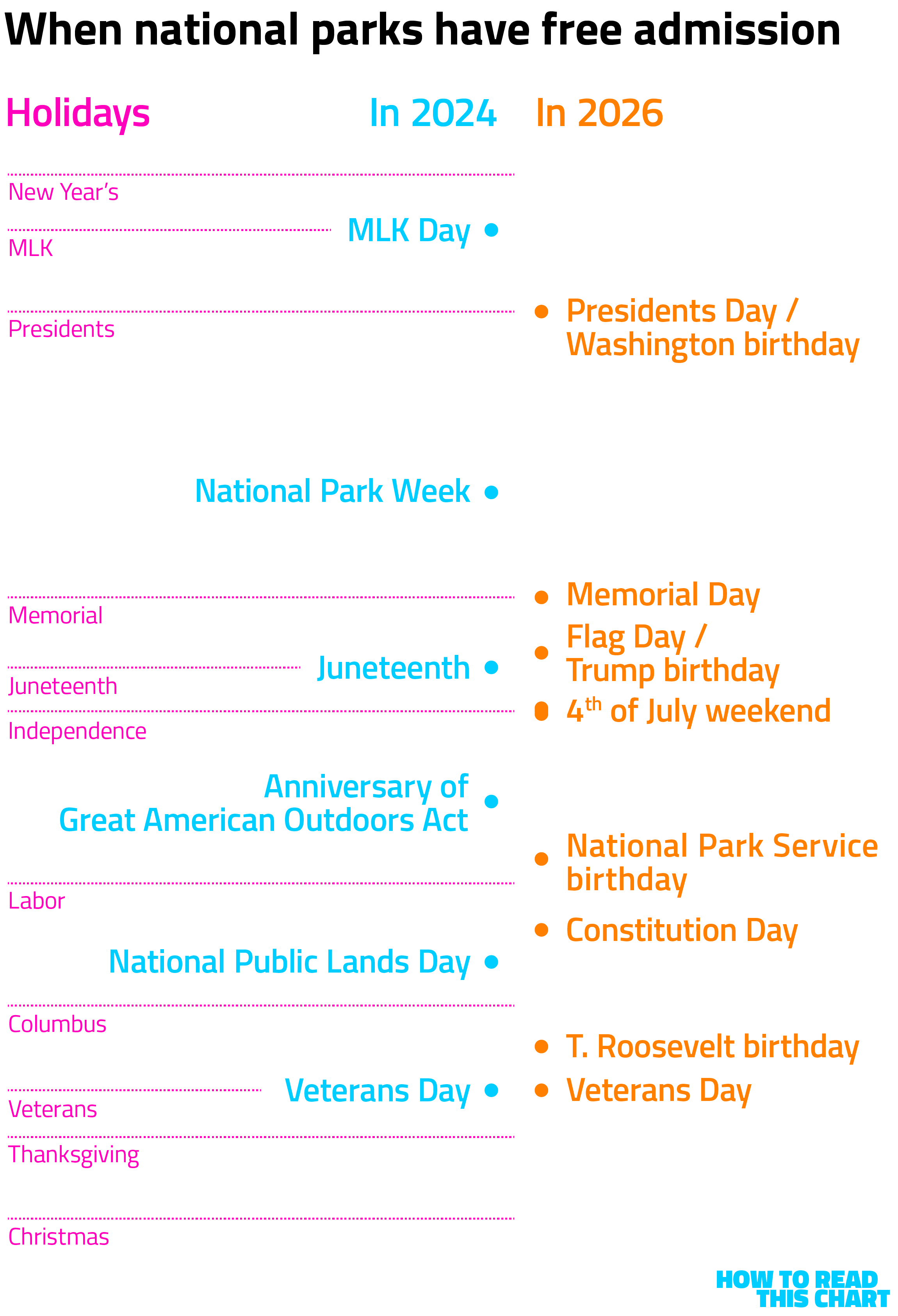
His birthday happens to overlap with Flag Day, which is a day that everyone 1) celebrates assiduously and 2) celebrates by visiting a national park, so it just makes sense.
I will say this, though: Free admission to national parks is a better deal for the American people than a sparsely attended, Soviet-style military parade.
Chapter 3
The new alliances of the new U.S.
Last week, the administration released a document detailing its strategy for national security. As I also wrote for MS NOW, it disparages Europe as a failing region, blaming the collapse in large part on — you guessed it! — immigration.
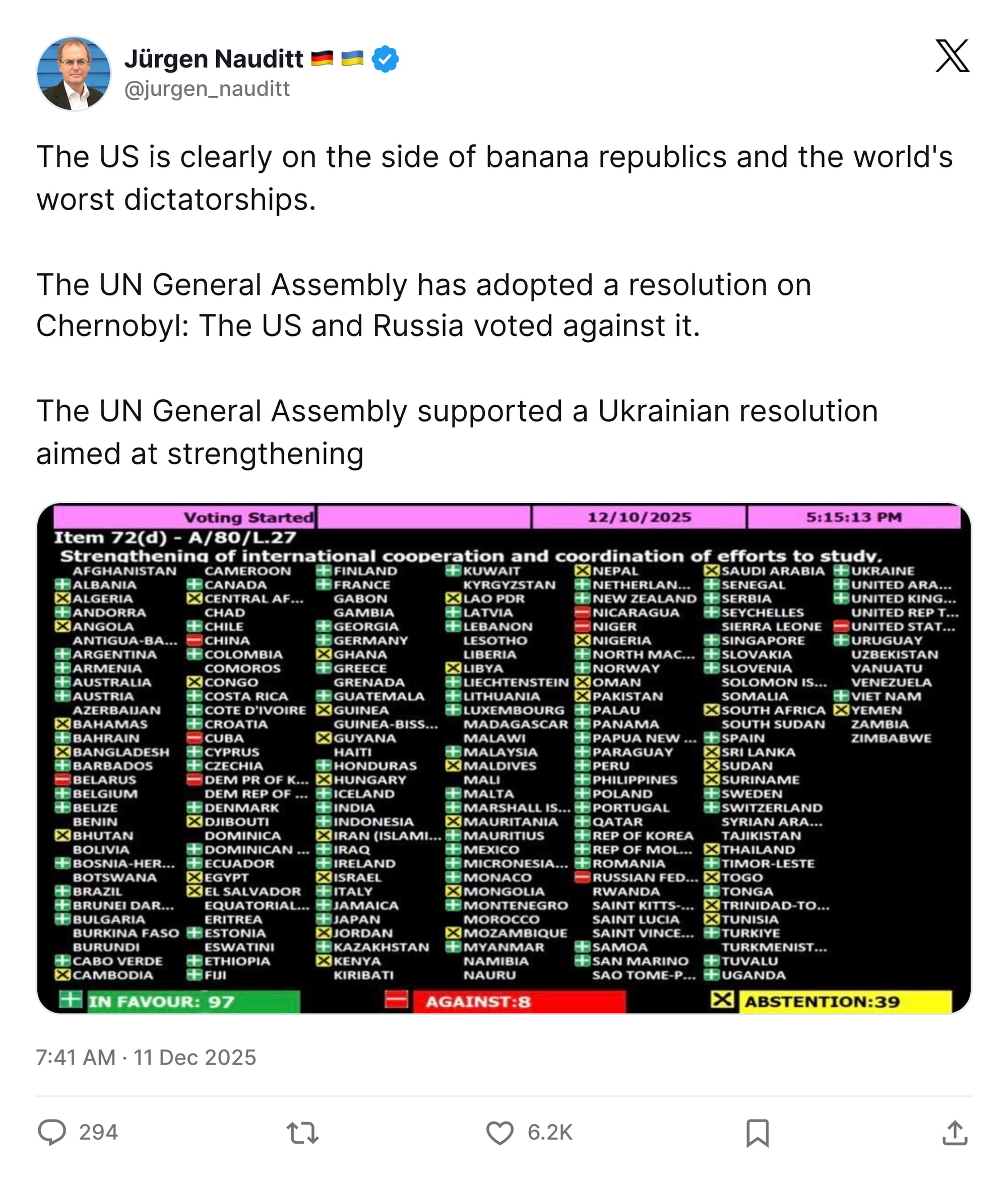
That hostility to our traditional allies was made manifest at the United Nations this week, as the U.S. sided with Russia and against our erstwhile allies on a vote centered on fixing the damage done to the Chernobyl nuclear meltdown site during Russia's invasion of Ukraine.
I was curious whether there was a change in the pattern of votes at the U.N. that reflects this shift in loyalties. Happily, the U.N. has a repository of voting data that facilitates such analyses.
As is the case with most things geopolitics, this was tricky. How do you measure conflicts with other nations? What constitutes "Europe"? I decided that a conflict was any vote in which Europe (defined as at least two-thirds of the E.U.'s current membership) and Russia (or the U.S.S.R.) were on opposite sides of a yes-no vote and the U.S. aligned with one or the other.
Below, the results of every vote in which such a conflict arose during any year since 1946.
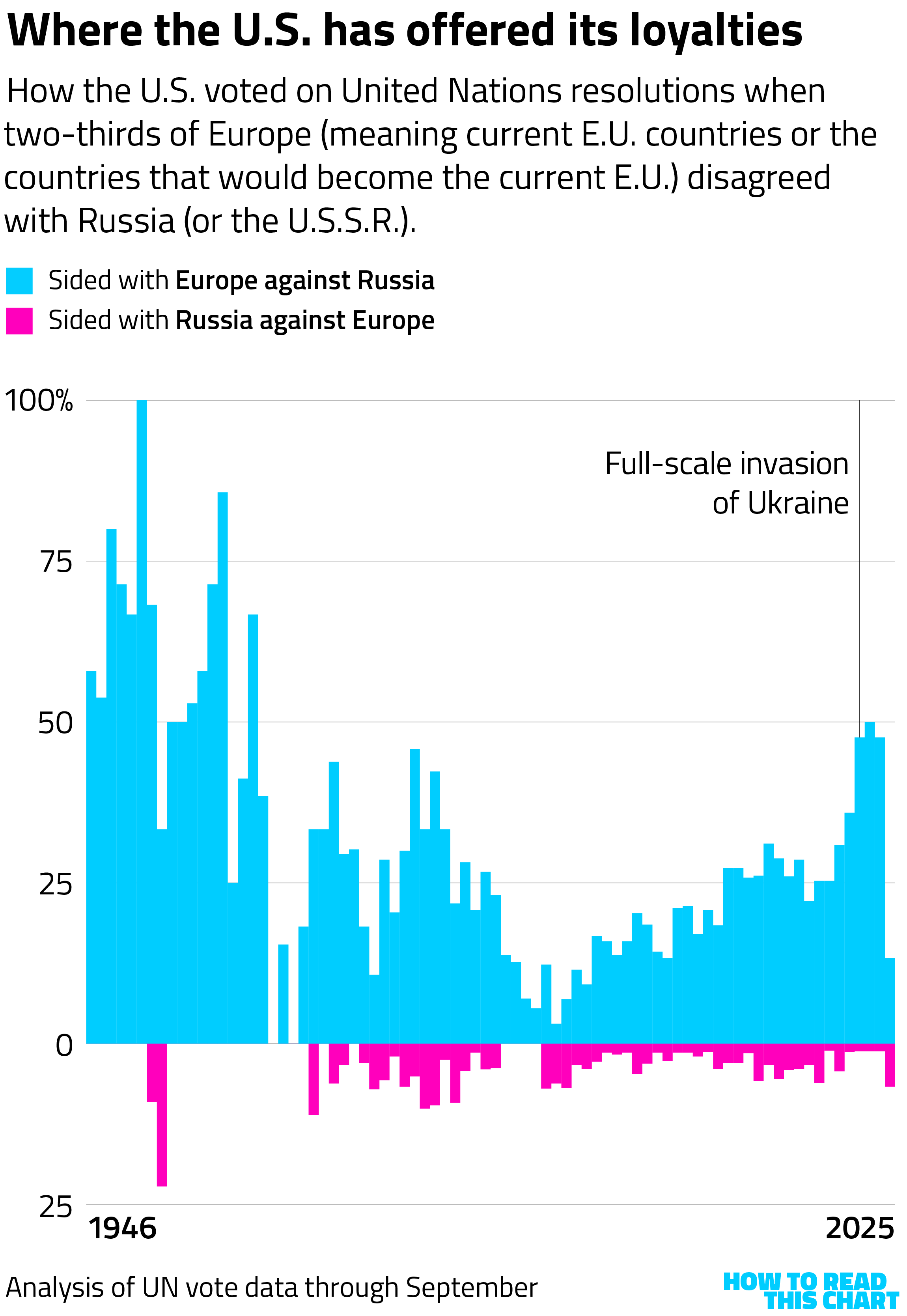
There's a spike in U.S. alignment with Europe since Russia expanded its Ukraine invasion in 2022. You can also see that the U.S. hasn't sided with Russia often this year — but that there has been an increase.
If we include abstentions as "no" votes (which is often what they are in practical terms), the shift becomes more acute.

We're dealing with a relatively small denominator here, 31 votes. But Trump's second term has been remarkably even-handed in its agreement with Europe and Russia — an obvious deviation from past presidencies, including his own.
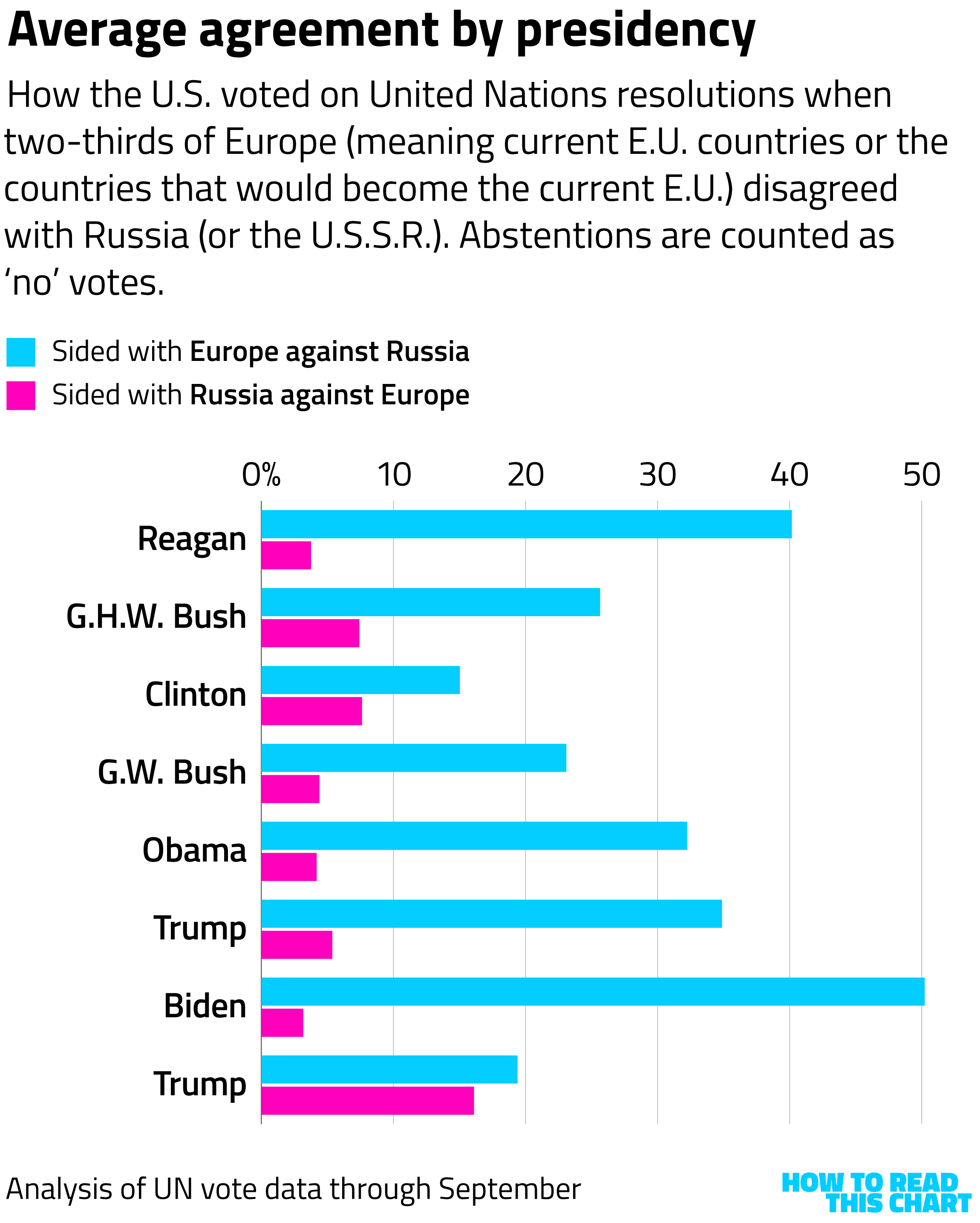
I'll repeat the caveat: this is a relatively small number of votes. But, once again, the data says what the data says.
Chapter 4
Chart Attack
I will be the first to admit that this particular iteration of the newsletter has not been what one might call "fun." Grim times are a rainstorm that drenches us all! So thank goodness we have Chart Attack, a series of small shelters offering dry warmth.
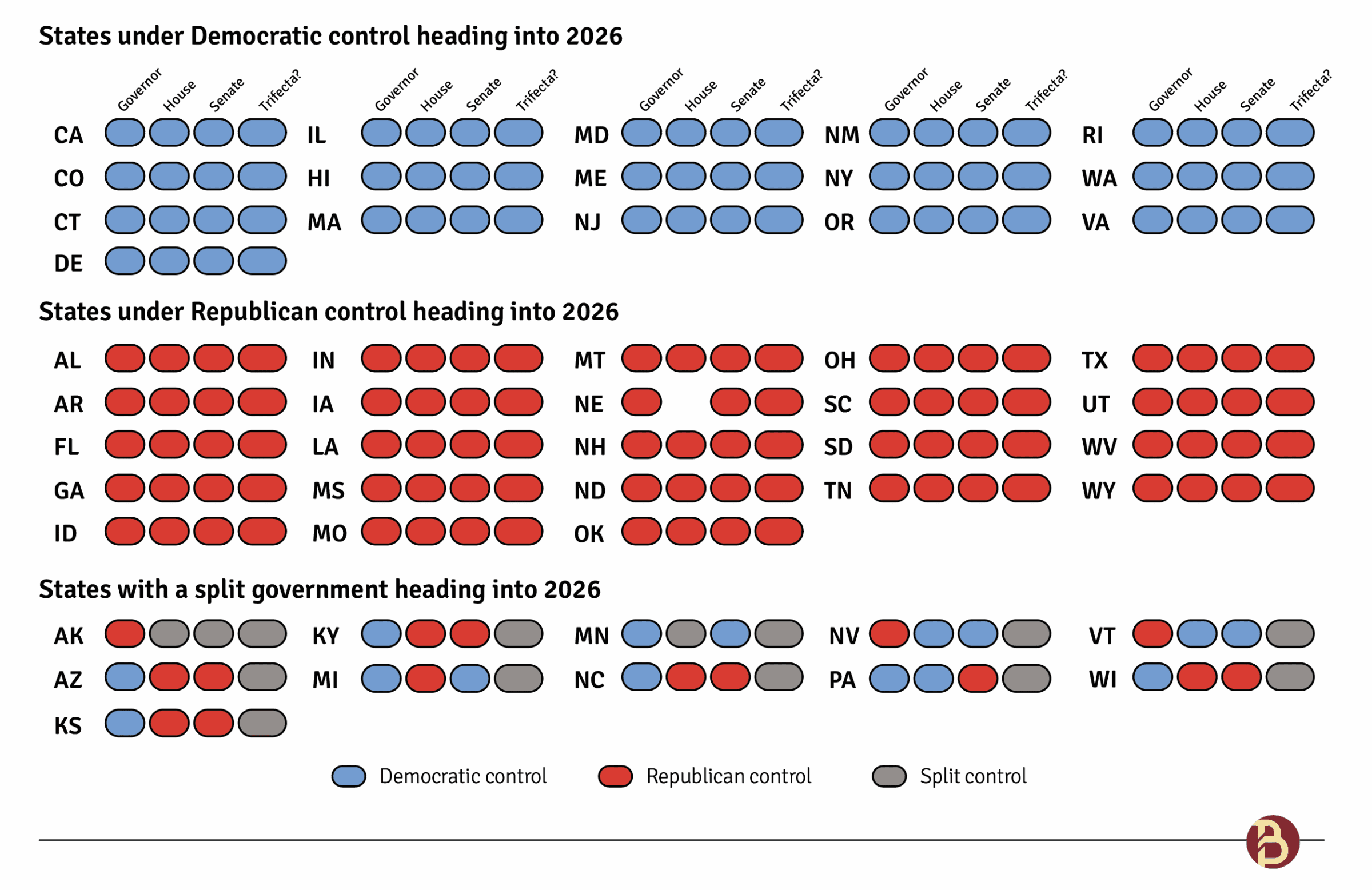
The 2025 election cycle finally concluded this week, allowing the excellent subnational political news site Bolts to compile its annual illustration of incoming state-level governance. The Democrats gained a trifecta (that is, control of both chambers and the governorship) in Virginia. Otherwise, not much changed.
Bloomberg continues its excellent visualization work with a deep dive on the true cost of protecting the U.S. from any missile strike. Lots of great data and fascinating explanation of how such a thing might (but probably wouldn't) work.

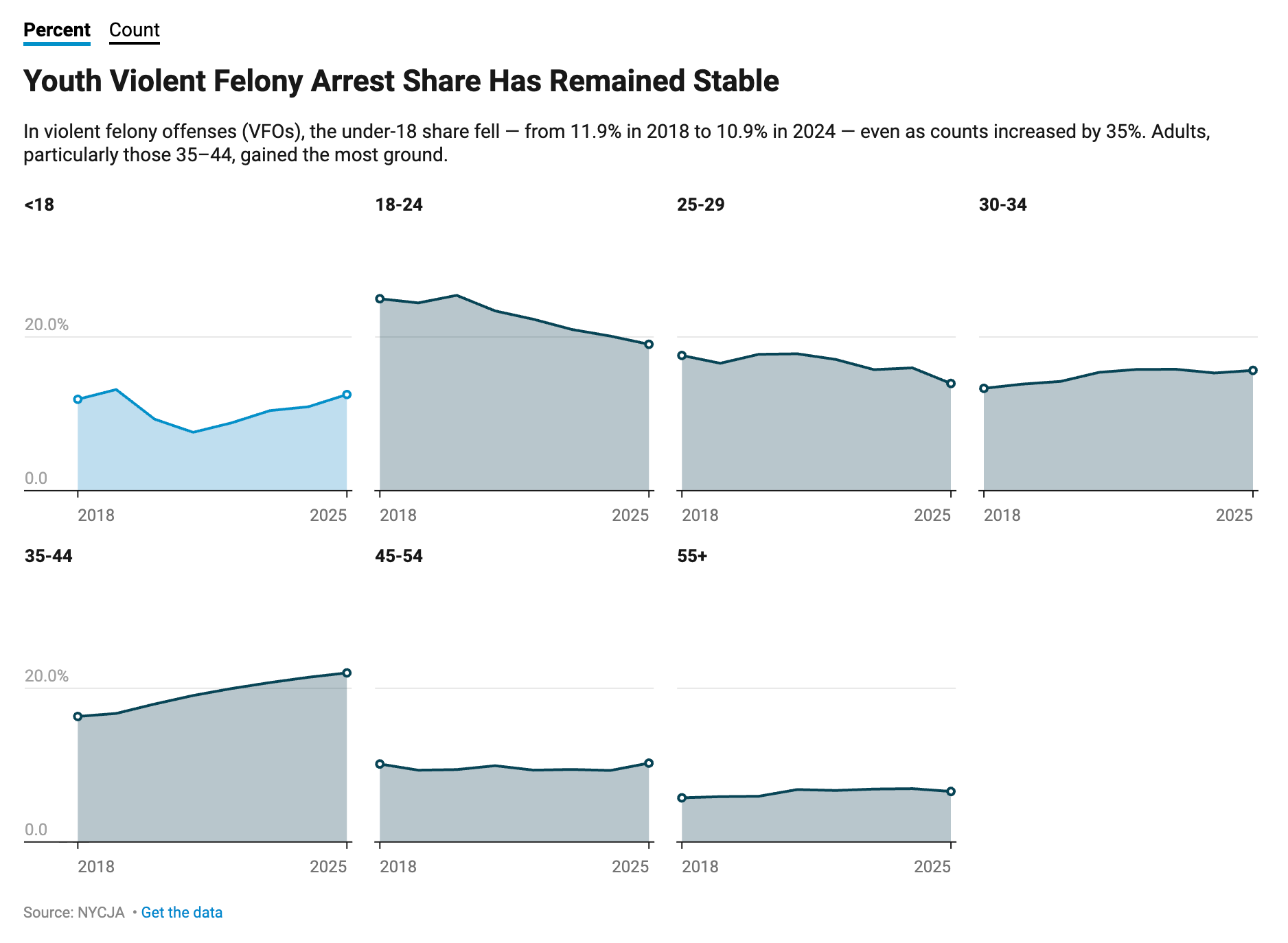
Not an exciting chart, but I thought this look at crime rates in New York City by age was fascinating. What's going on, 35 to 44 year-old New Yorkers? What are you so mad about?
I also stumbled across a video on Instagram that answered a question my kids recently asked me: How many people had ever lived? Click through to see the answer — and to see just how far down that Black Death line goes.
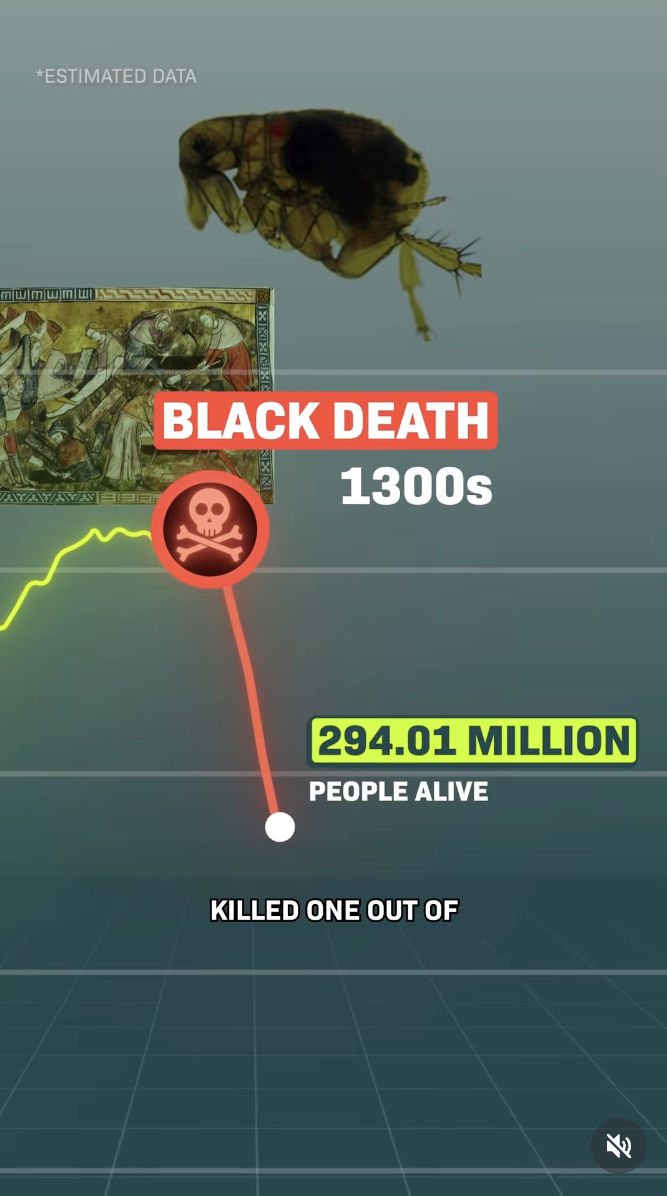
Not that we know what causes plagues, right? Maybe it's unbalanced humours? Who's to know?
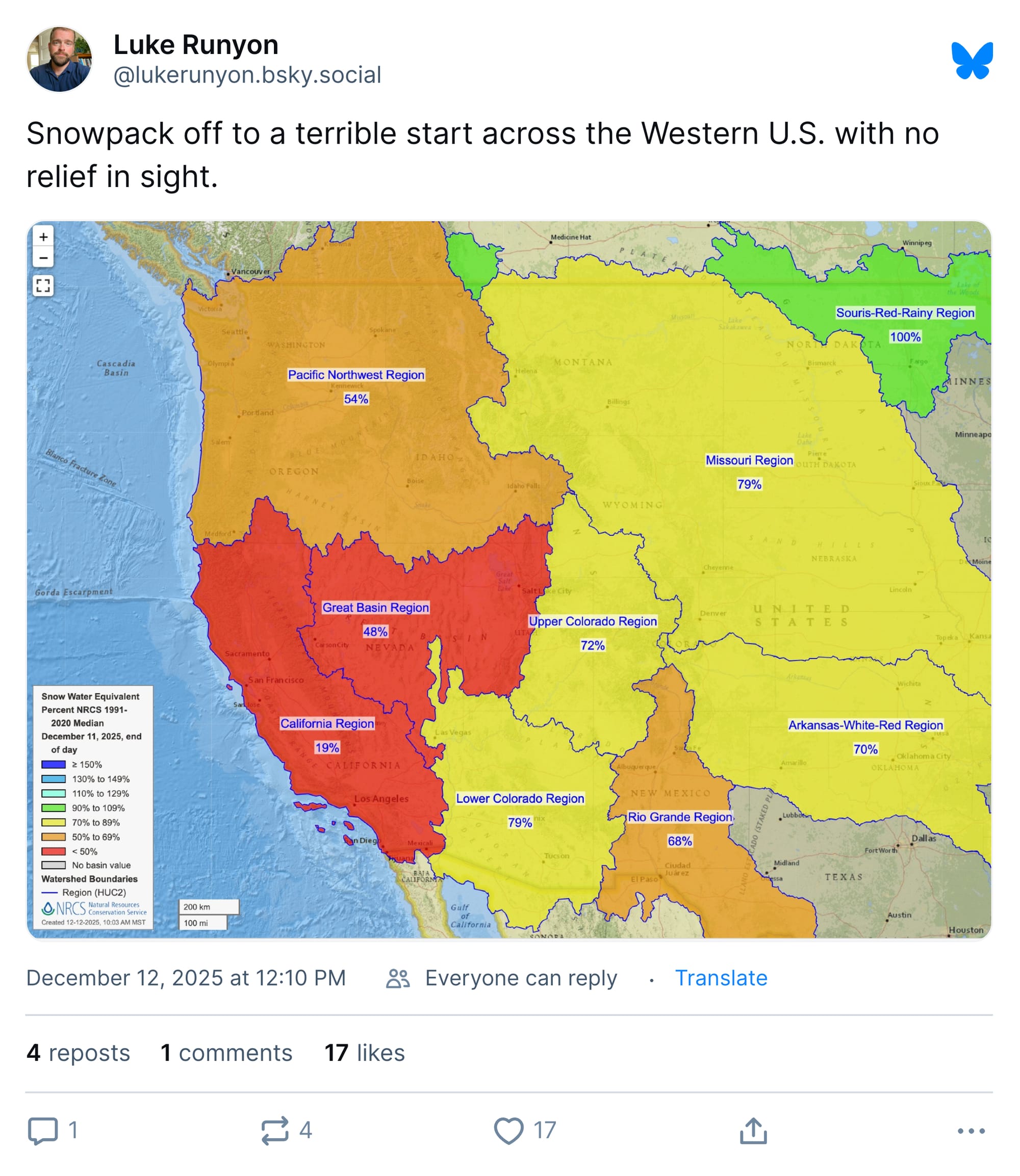
I appreciated this simple, disconcerting look at the hydrological future of the American West.
And now, at long last, we transition to actually fun stuff. Such as it is.
Like this chart showing when people are most likely to indicate break-ups via Facebook status updates. Cuffing season? More like uncuffing season.

I debated sharing the image below, from the appropriately named website Pornhub. Each year, the (impressively adept) marketing team there produces an overview of Americans' pornography consumption habits, most of which makes even me squeamish. I never shared it in this newsletter when I was at The Washington Post, recognizing that it was a bit too prurient. But now I'm my own man! I get to decide what is or isn't too adult. And this particular presentation falls juuuust within my own limits.
I'm not going to explain any of the more exotic terms here. But I will admit that I am sharing this in large part because Missouri's unique interest area is very amusing to me.
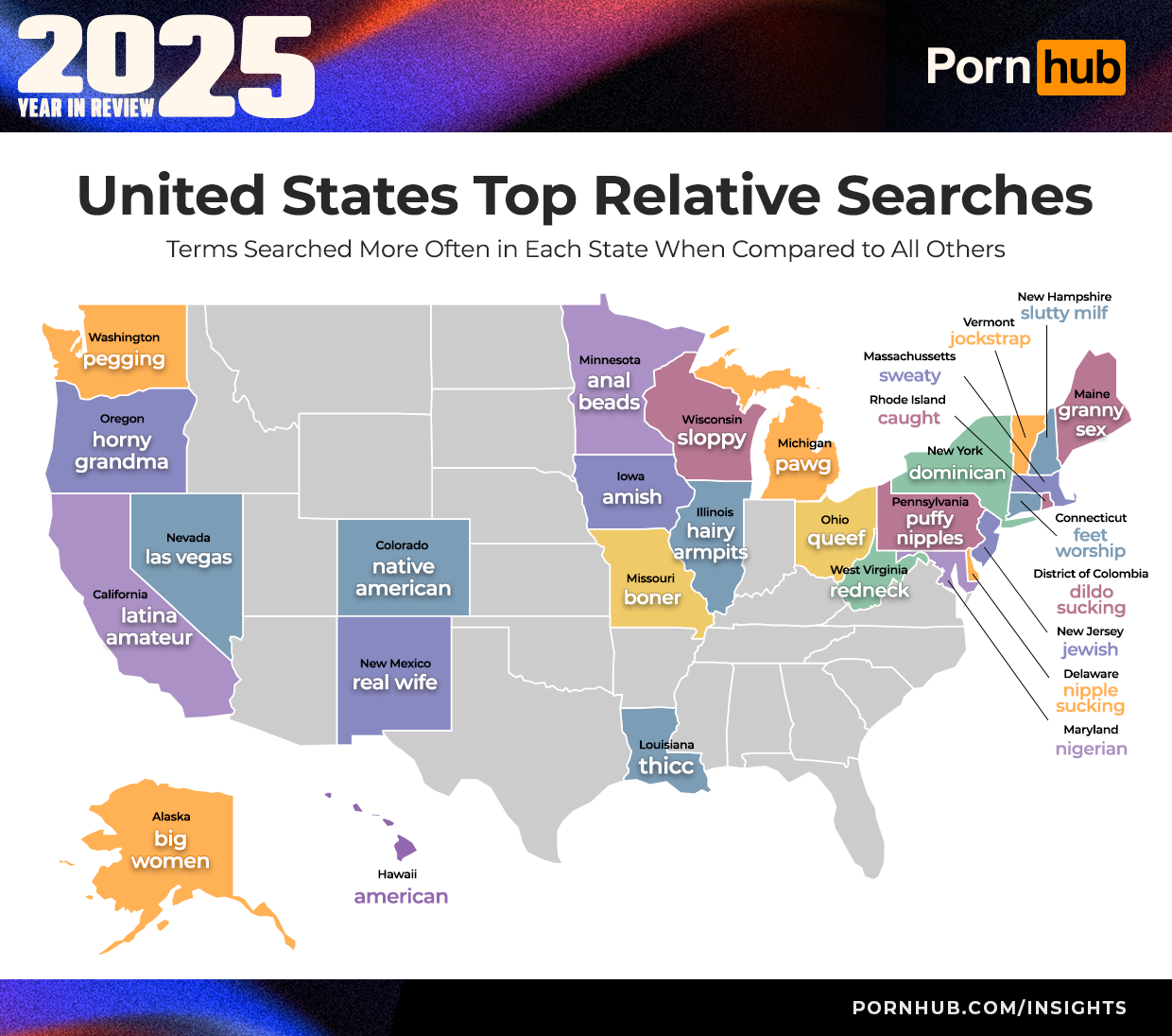
(I sincerely apologize if this is a little too blue for what you expect of this newsletter. But: Missouri! Come on! That's what people are searching for!)
I will end with a chart from YouGov that sits as far on the MPAA-rating scale as is conceivable from the chart above. Their polling team found a wide divergence on when Americans thought kids stopped believing in Santa — a divergence that correlated with when respondents themselves stopped believing in him.
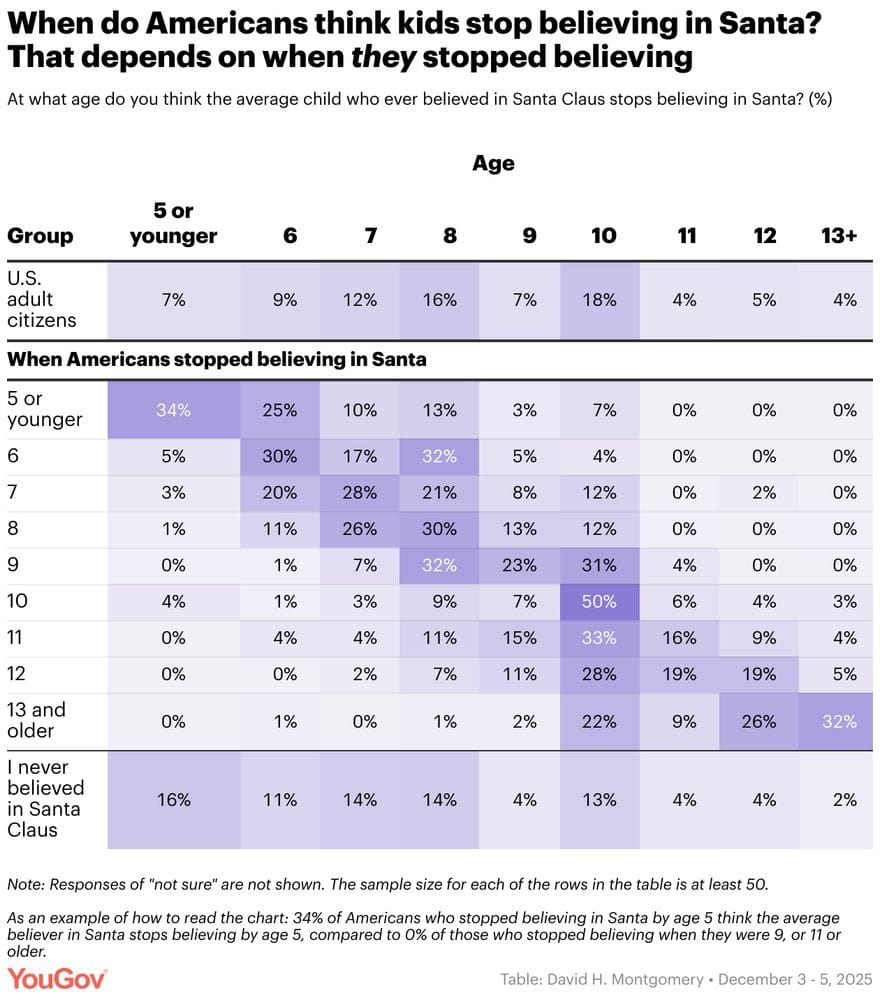
If there are any eight year-olds reading this newsletter who just learned 1) that Santa isn't real, 2) that Bay Staters are into sweat and 3) that the U.S. is under threat from a pro-authoritarian, fascistic regime? My apologies. But these are the things you learn when you start exploring data.
Appendix
Some other things I've written
 Anthony L. Fisher


 Anthony L. Fisher
You are receiving this email because you at some point in time volunteered to, either at Ghost or Substack or pbump.net or pbump.com. If you don't want to receive future emails, perhaps you, too, are an enemy of the people. Anyway, what you really want to do is support the newsletter financially, right?
Another, truncated issue is coming next week. You have been warned.